Overview of the Incident and Its Implications
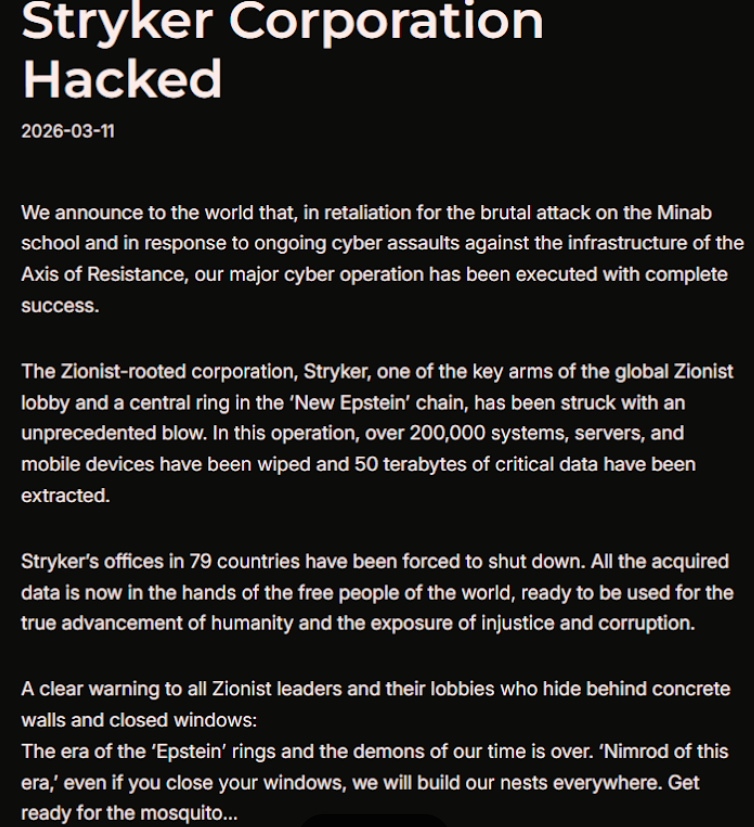
In early 2025, a devastating cyberattack hit Stryker, a leading global medical technology company headquartered in Kalamazoo, Michigan. The attack, claimed by the Iran-backed hacktivist group Handala (also known as Handala Hack Team), involved a wiper malware that erased data from over 200,000 systems, servers, and mobile devices across 79 countries. Stryker had to send home more than 5,000 employees from its Irish hub, while its headquarters reported a building emergency—likely a cover for the unfolding cyber crisis. This guide dissects the attack, explains the threat landscape, and provides actionable steps to defend your organization against similar wiper attacks.

Prerequisites for Understanding This Cyber Threat
Technical Knowledge
To fully grasp this tutorial, you should be familiar with basic cybersecurity concepts such as malware types (especially wipers), endpoint security, network segmentation, and incident response procedures. Knowledge of threat intelligence and attribution frameworks is helpful but not required.
Familiarity with Threat Actors
Understanding the geopolitical context is key. The Handala group is assessed by Palo Alto Networks to be a persona of Void Manticore, a threat actor affiliated with Iran's Ministry of Intelligence and Security (MOIS). Handala first emerged in late 2023 and has since targeted organizations in retaliation for perceived injustices, such as the February 28 Tomahawk missile strike on an Iranian school that killed over 175 people, most of them children. The United States was later held responsible for that strike.
Step-by-Step Analysis of the Stryker Wiper Attack
Step 1 – Recognizing the Attack Vector and Delivery Method
While the exact initial compromise vector for Stryker has not been publicly confirmed, wiper attacks often enter through phishing emails, exploiting unpatched vulnerabilities, or leveraging stolen credentials. In this case, reports indicate that affected employees found their devices wiped, with login pages defaced by the Handala logo. This suggests the attackers had broad network access, possibly via privilege escalation after initial foothold. Any organization should assume that wiper attacks can start with a single compromised user account.
Step 2 – Identifying the Malware Type (Wiper)
A wiper is malicious software designed to permanently destroy data on infected systems. Unlike ransomware, which encrypts data for extortion, wipers overwrite files to make recovery impossible without backups. In the Stryker incident, a trusted source confirmed that data was erased from over 200,000 endpoints—including servers, workstations, and mobile devices. The attack also wiped Microsoft Outlook data from personal phones, indicating a multi-platform spread. Common technical indicators include rapid disk I/O, unexpected system reboots, and large volumes of data being deleted.
Step 3 – Tracing the Attribution and Motivation
Handala’s Telegram manifesto explicitly stated the attack was retaliation for the February 28 missile strike on an Iranian school. The group’s ties to Iran’s MOIS were previously documented in threat intelligence reports by Palo Alto Networks. Handala is one of several personas used by Void Manticore, a state-sponsored group known for destructive attacks against organizations in countries perceived as adversaries. Understanding attribution helps defenders anticipate targets and adopt appropriate countermeasures.
Step 4 – Understanding the Impact and Response
Stryker’s network was effectively shut down. Employees in Cork, Ireland—Stryker’s largest hub outside the U.S.—were sent home after systems failed. Communication shifted to WhatsApp, as official channels were compromised. The company’s headquarters voicemail cited a “building emergency,” a common obfuscation tactic. The attack disrupted a medical technology firm with 56,000 employees and $25 billion in annual sales, highlighting how wiper attacks can cripple critical infrastructure and healthcare supply chains. Immediate response steps included isolating affected systems, preserving forensic evidence, and notifying law enforcement.
Defensive Measures and Mitigation Strategies
Implement Robust Backup and Recovery Plans
The single most effective defense against wipers is maintaining offline, immutable backups. In Stryker’s case, having backups that were not connected to the network would have allowed faster recovery. Use the 3-2-1 rule: three copies of data on two different media, with one copy off-site and offline. Regularly test restoration procedures to ensure backups are not corrupted or targeted.
Deploy Endpoint Detection and Response (EDR)
EDR solutions can detect unusual behavior such as mass file deletion or unauthorized cryptographic operations. Configure alerts for processes like vssadmin delete shadows or high-volume file modification in short time frames. EDR tools often provide rollback capabilities to reverse damage in some cases.
Harden Network Segmentation and Access Controls
Limit the blast radius of any intrusion by segmenting networks. Critical systems (e.g., medical devices, patient data) should reside in separate zones with strict firewall rules. Implement least privilege access: employees should only have permissions necessary for their roles. In the Stryker attack, the ability to wipe 200,000+ systems indicates weak segmentation and over-privileged accounts. Use multi-factor authentication everywhere, especially for administrative accounts.
Establish Communication Channels for Incidents
When primary systems fail, alternative communication methods (like the WhatsApp use seen at Stryker) are vital. Pre-establish secure out-of-band channels: dedicated Slack/Teams workspaces on separate infrastructure, or even SMS/Call trees. Ensure that incident response teams have offline access to emergency playbooks and contact lists.
Common Mistakes Organizations Make
Assuming Wiper Attacks Are Rare
Many organizations focus on ransomware and overlook wipers, but nation-state actors increasingly use wipers to deliver a knockout blow. The Stryker incident shows that any company can be a target, especially those in sectors like healthcare, energy, or defense. Prepare as if an attack is imminent.
Neglecting Offline Backups
If backups are network-accessible, wipers can delete them too. The attack in this case erased data from servers, likely including backup repositories. Always maintain air-gapped backups that require physical or separate administrative access.
Overlooking Insider Threats and Social Engineering
Handala likely gained entry through spear-phishing or credential theft. Employees need continuous training on recognizing phishing attempts, especially those referencing geopolitical events—attackers often exploit emotional triggers. Also, monitor for unusual account activity, such as logins from unexpected locations or devices.
Summary
The wiper attack on Stryker by the Iran-backed Handala group underscores the growing threat of nation-state cyberattacks that use data destruction as a weapon. This guide walked through the attack’s details—over 200,000 systems wiped, employee displacement, and geopolitical motivation—and provided concrete defensive measures: robust offline backups, EDR deployment, network segmentation, and incident communication plans. By learning from Stryker’s experience, your organization can better prepare for and mitigate the devastating impact of wiper malware. Stay vigilant, test your defenses regularly, and never underestimate the targetability of your enterprise.